
Pressure Washing Vinyl Siding Without Wrecking It
October 21, 2026
☑️ 150% Money-Back Guarantee | Family Owned Since 1998
10815 Beaver Dam Rd Suite A, Cockeysville; MD 21030
☑️ Lifetime Warranty on Installations
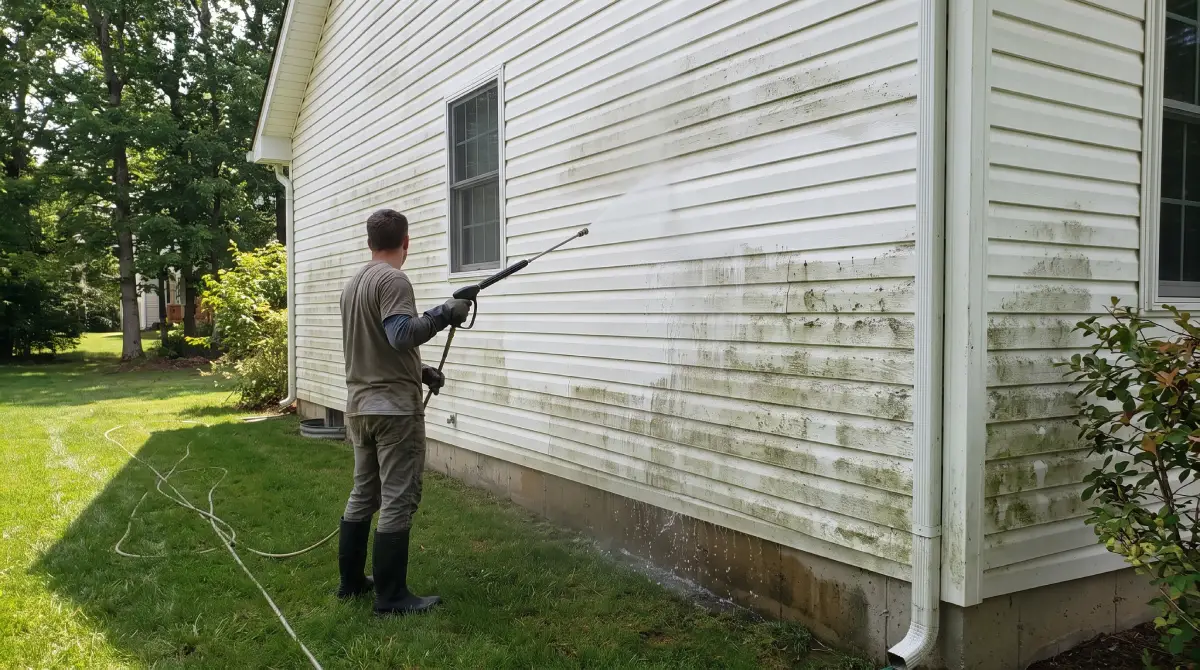
Every spring I hear some version of the same story. Somebody rents a gas pressure washer for the weekend, and by Sunday night there’s a damp spot on the inside of a kitchen wall. Inside. Yep. They were pressure washing vinyl siding from the ground up, wand angled toward the sky, and pushed water right up under the laps and behind the panels. Usually nothing’s ruined, but it means a fan and a dehumidifier running for a couple of days before that drywall feels normal again.
So is pressure washing vinyl siding safe? Mostly, if you go about it the right way. Vinyl is tough stuff. Most of what people call “damage” from a washer is really water getting somewhere it shouldn’t, or a zero-degree tip carving a line into a panel that was already brittle from twenty summers of sun.
Short answer, it can be. Longer answer has to do with how the stuff is hung. Siding panels are built to shed water running down them, kind of like shingles on a roof. They are not built to stop water blasting up at them from below.
Each panel locks into the one under it and hangs a little loose on its nails (installers do that on purpose so it can expand and shrink with the weather), and that little gap is exactly where a hard upward spray goes. Check your siding maker’s care sheet, or the Vinyl Siding Institute, before you settle on a pressure setting.
Here’s what usually goes wrong when somebody gets carried away:
None of that means power washing siding is off the table. You just have to respect the machine a little.
People ask me what PSI to use when they clean vinyl siding, like there’s one magic number. Honestly the nozzle and the distance count just as much. A 3,000 PSI machine with a white 40 degree tip held three feet off the wall is gentler than a 1,500 PSI unit with the red zero-degree tip six inches away. Who’d guess, right?
If you want to clean vinyl siding yourself with a washer, here’s roughly where I’d land. Keep it somewhere around 1,300 to 1,600 PSI if your machine lets you dial it down. Use the 25 or 40 degree tip, never the red one (I’d stick that red tip in a kitchen drawer before you start so nobody grabs it by accident). Stand two to three feet back. Spray straight on or slightly downward, never up into the seams. Test a spot behind a bush first, because some older siding just can’t take it.
For power washing siding on a two-story house, a ladder plus a kicking wand is a bad combo. I’ve watched it go wrong. An extension wand or a soap nozzle that reaches the second floor from the ground is the safer way, or call somebody who does it every week.
Here’s the part most folks don’t realize. Plain dirt on siding isn’t really the issue. That green and black stuff is alive. Algae, mildew, a little lichen down low sometimes. You can blast it off and the wall looks great for a few months, then it’s back, because you knocked the top off and left the rest hiding in the wood-grain texture of the vinyl. That’s why pressure washing vinyl siding with plain water rarely lasts.
A soft wash siding job flips that around. Low pressure (garden hose territory, really) plus a cleaning solution, usually a diluted bleach-based mix with a surfactant so it clings to the wall. You let it sit several minutes, then rinse gently. The cleaner kills the growth and the water just carries it off. Less force on the panels, a lot less water behind them, and the house stays clean longer.
A couple of warnings if you try to soft wash siding at home. Bleach mixes will brown your hostas and boxwoods if you’re sloppy, so we soak the plants with plain water before and after. We also don’t let the solution dry on a wall in full sun, because it streaks. Doing it yourself? Pick an overcast morning. And skip straight household bleach in a pump sprayer. Too strong, hard on the shrubs, hard on your eyes.
If one side of the house looks like it’s growing a lawn and the other three look fine, I’d bet money that’s the north side. Or the side behind the big oak. Shade plus moisture is all algae needs. The sun never hits that wall long enough to dry it out after a rain, so the green moves in and stays. We see it constantly on the wooded lots out in Monkton and White Hall, and in plenty of Towson neighborhoods too where the trees are older than the houses.
A good soft wash siding treatment fixes it for now. To slow it down, trim branches back so some light gets through, clean out the gutters so water isn’t sheeting down the wall, and aim sprinkler heads away from the bottom course. Once a year is usually enough to clean vinyl siding on most houses around here. Some north walls need it every spring and there’s no way around that.
One more thing to check. Rub the siding with your palm. If your hand comes away white and chalky, that’s oxidation, the vinyl slowly breaking down from UV. Pressure won’t fix it and too much will leave it blotchy, so a gentle wash with a cleaner made for oxidized vinyl is the move. Sometimes the honest answer is that wall of panels is just near the end of its life.
Same machine, completely different surfaces. Concrete can take a beating. Wood can’t. I’ve seen pressure-treated decks where somebody held the wand too close and left the boards fuzzy like a peach (that’s called furring, the soft grain gets torn up), and now it’s a sanding job before anyone can stain.
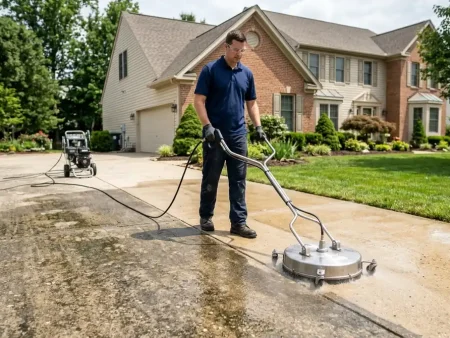
For a wood deck, go low, use a wide fan tip, keep moving and follow the grain. Let a deck cleaner do the heavy lifting. Composite boards are their own animal, so check what the manufacturer says first, since some don’t want you over a certain pressure at all. Concrete walks and driveways can handle a lot more, and a surface cleaner (that spinning disc thing) gives an even finish without zebra stripes. Oil spots and old gum need a degreaser and some patience.
Here’s where it loops back to my day job. Every bit of grime on your front walk ends up on somebody’s carpet eventually. Mud, driveway oil, that gray film from the street. I wrote about getting mud out of carpet a while back and the best tip in there is really keeping it outside in the first place.
For a business, the outside is the first thing anybody sees. Gum spots on the sidewalk, a dingy awning, black streaks running down the siding by the dumpster. Nobody writes it on a comment card, but they notice. Along York Road and out by the Beltway, a lot of strip centers are wearing years of exhaust film on their front walls.
Timing is a big deal with commercial work. We usually go early, before the doors open, or after close, so the walk is dry when customers show up. A storefront is pretty much the opposite of pressure washing vinyl siding on a house, too. Way more pressure on the concrete, a lot less on the building.
The smart move I see from good property managers is pairing the outside with the inside. Wash the walks and the entry, then get the lobby or hallway carpet cleaned that same week so nobody drags fresh grime across clean floors. We handle commercial carpet cleaning in Cockeysville for offices right near our shop, and the Baltimore commercial carpet side covers the bigger buildings in the city.
I’m not going to tell you a homeowner can’t clean vinyl siding on their own. You can. A one-story rancher in Parkville with a little mildew on the back wall? Grab a soft brush on a pole, a bucket of siding cleaner and a garden hose. Done by lunch, no rented machine.
Where I’d hire it out: two-story homes, anything that needs a ladder and a wand at the same time, heavy algae, oxidized siding, or a business where it has to be finished before 8 a.m. Also if you just don’t feel like spending a Saturday soaked to the knees. Fair enough.
If a crew is coming out for pressure washing vinyl siding at your place, a little prep helps a lot:
Last thing if you’re going the DIY route with power washing siding. Whatever you rent, read the tip chart on the side of the machine. Most of the horror stories I hear start with somebody who never looked at it.
Our shop is in Cockeysville off Beaver Dam Road, so we’re up in the north county all the time. If you’d rather not clean vinyl siding yourself, that’s what we’re for. Here’s more on our Cockeysville pressure washing, and if you’re further south there’s a page on pressure washing around Baltimore too. Hunt Valley, Phoenix, Glen Arm, Perry Hall and pretty much everywhere in between are on the regular route.
Extreme Carpet Cleaning LLC has been family-owned since 1998, and pressure washing sits right next to the carpet, rug, upholstery and duct work we do every day. If you’re thinking about floors while we’re out there, we also handle new carpet sales and carpet installation in Hereford and across Baltimore County, and every install comes with a lifetime warranty. Our cleaning work is backed by a 150% money-back guarantee.
Got a green wall and zero interest in power washing siding from a ladder? Call us at (410) 666-6600 or request a free quote online. I’ll tell you straight whether it needs a soft wash, a light rinse, or just a brush and a hose.



Tell us a little about your project. We’ll come out, take a look, and send you a written quote within one business day.