
What to Do After Basement Flooding: The First 48 Hours
October 21, 2026
☑️ 150% Money-Back Guarantee | Family Owned Since 1998
10815 Beaver Dam Rd Suite A, Cockeysville; MD 21030
☑️ Lifetime Warranty on Installations
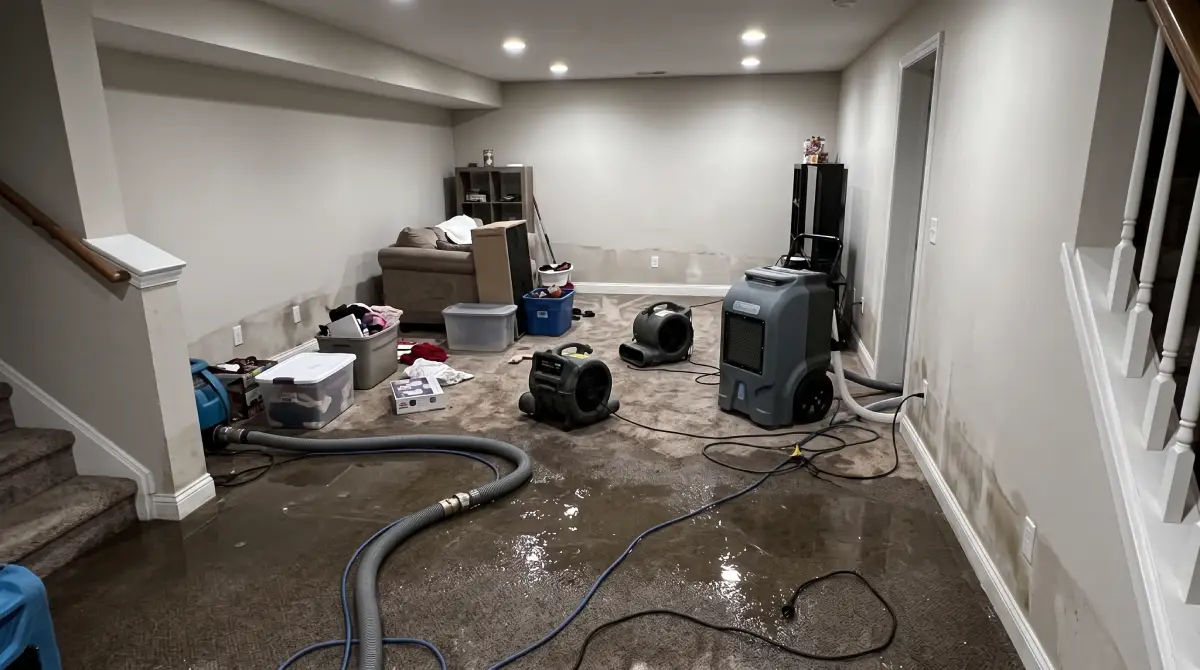
First thing. If the water’s still down there and it’s anywhere near an outlet, a power strip, the furnace or an extension cord, stay off the stairs. Everything else in this post can wait ten minutes. None of the advice about what to do after basement flooding matters if you get shocked halfway down the steps.
Okay. I’m Shawn, I’ve been running Extreme Carpet Cleaning LLC since 1998, and after a big storm a good chunk of our calls are basements. Maryland basements take on water every way you can think of. Sump pump quits in the middle of the night. Water heater lets go. A washer hose splits while everybody’s at work. Groundwater pushes up through the slab after a week of rain. Here’s how I’d handle a flooded basement in the first day or two, roughly in the order I’d do it.
If you can reach your main electrical panel without stepping in water, shut off power to the basement, or the whole house if you don’t trust the labels on the breakers (most people shouldn’t). If the panel is down in the basement and you’d have to wade to it, don’t.
Call the power company or an electrician and let them kill it. A flooded basement with live circuits is how people get hurt, and rubber boots are not a plan. The EPA mold guidance says to dry wet stuff within 24 to 48 hours, and that lines up with what we see on jobs.
Smell gas? Get out and call the gas company from outside. Don’t flip light switches on your way out. And if the furnace, water heater or any other gas appliance sat in water, have a licensed tech check it before it gets fired back up. Controls and valves that went underwater usually need replacing, not drying.
One more people forget. If you rent a gas pump or run a generator, it stays outside. Not in the basement, not in the garage with the door cracked. Carbon monoxide doesn’t care how careful you thought you were being.
Honestly this changes everything about basement flood cleanup, so take a minute with it. In my line of work we sort water into three rough groups:
And clean water doesn’t stay clean. Give it a couple days soaking into carpet and drywall in a warm basement and it’s growing things.
Sewer backup is the one basement flood cleanup job I really don’t want homeowners tackling alone. It carries bacteria and viruses, and porous stuff it soaks into (carpet, pad, drywall, insulation, cardboard boxes, upholstered furniture) generally can’t be made safe again. All of that gets bagged and thrown out. If you have to go down there, wear rubber gloves, boots, eye protection and at least an N95 mask. Keep kids and pets upstairs, don’t track it through the house, and wash up well afterward. Anyone with a weak immune system should stay out entirely.
Once it’s safe, move. With basement water damage, mold can start growing on wet materials in about 24 to 48 hours, and a basement in a Maryland summer is pretty much an incubator.
Take pictures first. Lots of them. The water line on the walls, furniture sitting in it, the source if you can see it, model numbers on appliances. Then call your insurance company. Policies often treat a sump failure or sewer backup differently from a burst pipe, and the adjuster will want to see basement water damage before it’s all out on the curb. Ask them. Don’t guess. Most policies also expect you to take reasonable steps to stop things from getting worse, so don’t sit and wait on a callback with water on the floor.
Then stop the water if you can. Close the main shutoff if it’s a supply line. Get the sump running or swap it out. If it’s coming in from outside, sometimes there’s nothing to do until the rain quits, which is frustrating, I know.
Got a couple feet of water and soaked ground outside? Don’t pump it all out in one shot. Saturated soil pushes hard against the outside of your foundation, and the water inside is pushing back. Drain the basement too fast and a wall can crack or even bow in. Emergency management folks usually say take it down in stages, roughly a third a day.
Then get stuff out. Wet boxes, the old couch, the kids’ toys you meant to sort anyway. Up to the driveway or the garage, so the room can start drying. Area rugs that only took clean water can sometimes be saved if they get to a cleaning plant quick, so set those aside instead of tossing them.
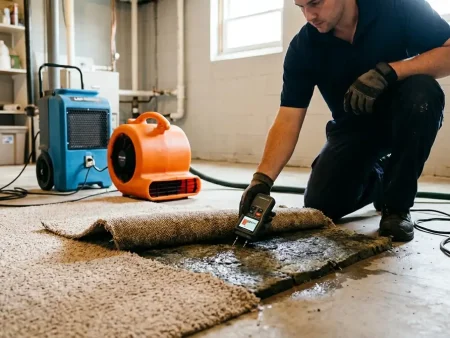
In a flooded basement, pad goes. Almost always. The foam under basement carpet holds water like a kitchen sponge, it won’t dry well in place, and it’s cheap next to everything else. If you only remember one thing from this section, pull the pad.
The carpet itself depends. Clean water, caught fast, dried right? It can often be cleaned and re-laid over new pad. Gray water is a judgment call that depends how long it sat. Sewage or outside floodwater, it’s gone, no debate. I wrote a whole post on how long carpet takes to dry if you want the timing details.
Drywall is where basement water damage likes to hide, because it wicks water upward, sometimes well above the line you can see. Pros usually cut it out a foot or two above the water mark (a flood cut), pull the wet insulation behind it, and let the studs dry before anything goes back. Poured concrete and block walls are more forgiving. They just need time and airflow.
Trim and shelving? Particleboard swells and falls apart, so don’t bother saving it. Solid wood baseboard can sometimes come off, dry out and go back on.
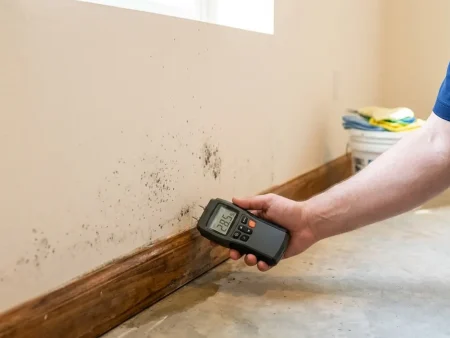
Here’s where a lot of DIY basement flood cleanup goes sideways. The floor looks dry on day two, the fans get unplugged, and a week later there’s a musty smell and gray spots creeping up the bottom of the drywall. Surface dry isn’t dry. Concrete holds a lot of moisture, and wall cavities hold more.
What actually dries out basement water damage is air movement plus dehumidification. Box fans help a little. A household dehumidifier helps a little more if you empty it constantly. Commercial air movers and big dehumidifiers running around the clock, checked daily with a moisture meter, get it done in days instead of weeks. That’s what our water damage restoration team in Cockeysville sets up on a job.
Same process down in the city, too, where our Baltimore water damage restoration crews deal with rowhome basements that have one tiny window and zero airflow. Those take patience.
Open the windows? Only if it’s drier outside than in. On a muggy July afternoon in Baltimore County, cracking the basement windows just lets more moisture in. Shut them and let the dehumidifiers work.
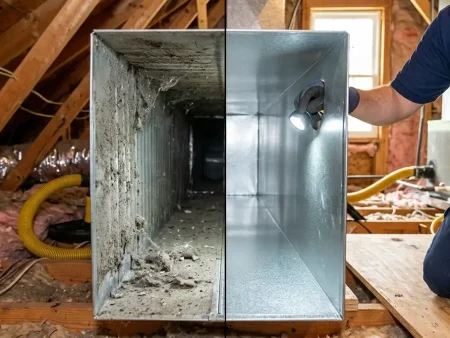
Nobody thinks about ducts until the whole house starts smelling like the basement. In a lot of homes around here the furnace or air handler lives down there, along with the lowest duct runs. If water got into floor registers, a return sitting on the floor, or the bottom of the air handler, you’ve now got a dark, damp metal tube connected to every room in the house.
Silt dries into dust inside those runs. Wet insulation on flex duct can hold moisture for a long time. And if mold gets going in the system, every time the blower kicks on it’s pushing spores and that musty smell upstairs. Running the HVAC while the flooded basement is still wet also spreads humid air around the house, so I’d hold off until things are drying and the equipment’s been checked by an HVAC tech.
After basement water damage that reached the HVAC, have the ducts looked at and cleaned once everything’s dry. We do air duct cleaning in Cockeysville right out of our own shop, and we’ve done plenty of Towson duct cleaning after spring storms, when the older houses off York Road and Loch Raven take on water.
Up around the business parks and the newer developments, our Hunt Valley air duct crew sees it too, usually from a failed sump or a water heater nobody knew was leaking. And older homes with ducts running along a damp basement ceiling for decades need it most of all, which is a lot of what our duct cleaning around Baltimore runs into. Curious how often ducts should get done even without a flood? Here’s my take on air duct cleaning frequency.
Bleach on everything. Bleach can sanitize a hard, nonporous surface, but it won’t reach mold growing inside drywall or wood, and the water in it just adds moisture. Plus mixing it with other cleaners can make toxic fumes. Remove what’s ruined, dry the rest, then clean.
Using the household vacuum on water. Please don’t. That’s a shock risk and a dead vacuum.
Putting carpet back down too soon. If the slab’s still damp, you’re sealing moisture under new pad and starting the whole mold clock over. Same with painting over water stains on drywall that never got opened up.
And waiting. I get it, it’s overwhelming, and you’re calling the insurance company and the plumber and your brother-in-law all at once. But every day a flooded basement sits wet, more stuff goes from “dry it out” to “throw it out.”
We’re a family-owned company out of Cockeysville, IICRC certified, with truck-mounted extraction that pulls a lot more water out of carpet than any rental unit. Cleaning and repair work is covered by our 150% money-back guarantee. Once the basement’s dry and you’re ready to redo the floor, we also do new carpet sales and carpet installation in Glen Arm and across the area, and installs carry a lifetime warranty.
Where we work: all over Baltimore County, from Perry Hall and Parkville up to Hereford and White Hall. We’ll also send crews for air duct cleaning out in Reisterstown and duct cleaning down in Annapolis when a flood has the whole system smelling off.
That’s the honest version of what to do after basement flooding, from somebody who’s waded through a lot of them. Water on the floor right now? Call (410) 666-6600. Already past the emergency and figuring out basement flood cleanup or the ducts afterward? Request a free quote and I’ll have someone take a look.


Tell us a little about your project. We’ll come out, take a look, and send you a written quote within one business day.