
Upholstery Cleaning Codes W, S, WS and X: What the Tag Means
October 22, 2026
☑️ 150% Money-Back Guarantee | Family Owned Since 1998
10815 Beaver Dam Rd Suite A, Cockeysville; MD 21030
☑️ Lifetime Warranty on Installations
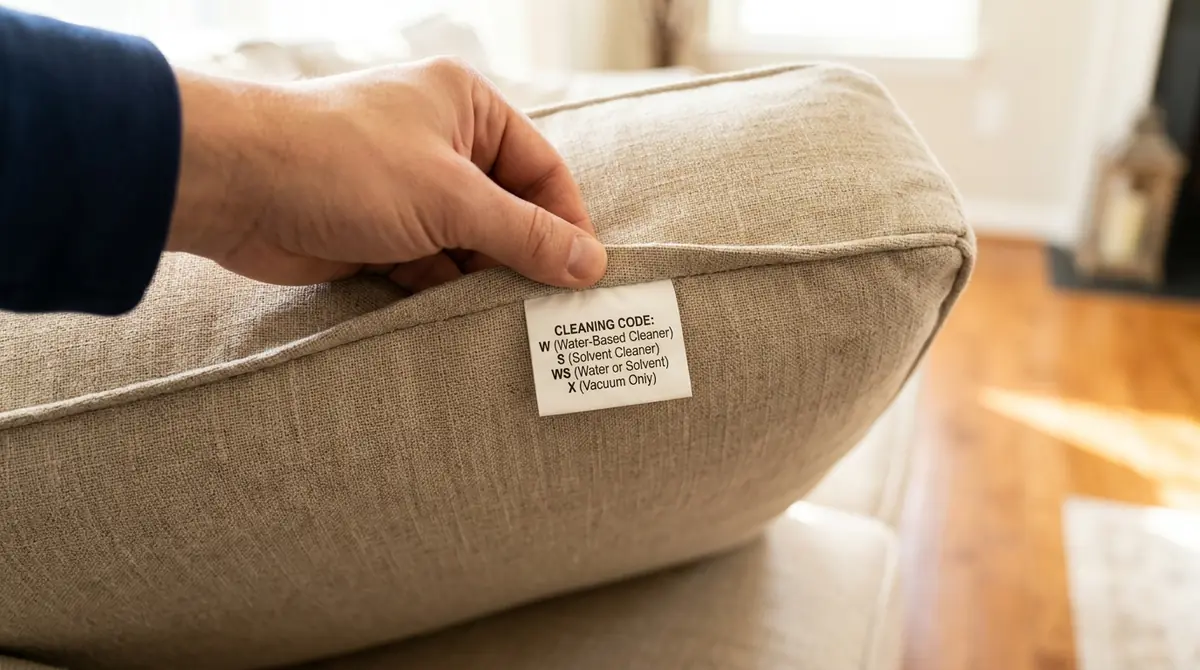
Go flip a cushion. I’ll wait. We’re looking for your upholstery cleaning codes, and they’re almost always hiding under there.
Somewhere under the seat, or on the deck under the cushions, or stapled to the bottom of the frame, there’s a tag with a single letter on it. W, S, WS (sometimes written S/W) or X. That letter is your couch cleaning code, and it tells you what kind of cleaner the fabric can take. Most people have never looked. Then they grab a bottle of carpet spot remover, go at a juice stain, and end up with a bigger ring than the original spill. I’ve cleaned furniture around Baltimore County since 1998, and I’d say a solid chunk of the “can you fix this” calls I get start with exactly that.
Okay. Letter by letter, then, and what my guys actually do when they see each one.
Usually on the deck, which is the flat part under the seat cushions. Sometimes on the underside of the couch, on a white tag that also has the fiber content and the “do not remove under penalty of law” thing (you can remove it, by the way, that rule’s for stores, but leave it on anyway, it’s useful). Zip-off cushion covers sometimes have their own tag inside.
No tag at all? Happens a lot with older pieces and hand-me-downs. More on that later. And if you find two letters on two different tags, the stricter one wins. Go with whatever’s more careful.
W means the fabric can be cleaned with water-based cleaners. This is the easy one. You’ll find W on a lot of cotton blends, most polyester and olefin, and pretty much every “kid-proof” performance fabric the furniture store bragged about. A mild upholstery shampoo works, or a few drops of dish soap in a cup of water. Dab on, dab off.
Don’t drown it, though, W or not. Get a cushion too wet and the water runs down into the foam and the wood frame, grabs whatever’s been sitting in there for years, then creeps back up as it dries and leaves a brown ring right where the spot used to be. Ask me how many of those I’ve fixed. Damp, not wet. Blot, don’t scrub.
When we clean a W piece, it’s hot water extraction with an upholstery tool, light pass, lots of suction. Dries in a few hours with a fan on it. Of all the upholstery fabric codes, W is the one where a decent DIY job is actually realistic.
This is the one that bites people. S is solvent only, like the stuff a dry cleaner uses, and water is basically the enemy here. It shrinks, the dye runs, the nap goes flat and shiny, you get rings. Sometimes all four on one cushion. A lot of microfiber couches are S coded, and so are some rayon blends and fancy velvets.
The trouble is, you can’t really buy good upholstery solvent at the grocery store, so people use what’s under the sink. Which is water-based. Ring. Every time. That’s the part of the couch cleaning code system that trips up the most people, because nothing on the bottle says “not for S fabric.”
Some folks swear by rubbing alcohol on S coded microfiber, and honestly it can work on some of them for small spots, since it evaporates fast. But test it somewhere hidden first. I did a whole write-up on how to clean a microfiber couch if that’s what you’ve got.
Of all the furniture cleaning codes, S is the one where I’d say just call somebody for anything bigger than a coffee drip.
WS, sometimes written S/W, means you can use water-based or solvent cleaners. Sounds like the best of both. It sort of is. Honestly, WS is my favorite of the upholstery fabric codes to find on a tag. In practice it means the fabric’s a little more forgiving, but I still treat it with some respect. Regular grime gets a mild water-based clean. The oily stuff, pizza grease, lipstick, that dark patch on the arm where somebody’s head lands every night during the game, that gets solvent.
Test it on the back of the skirt or under a cushion first. Yes, every time. Doesn’t matter what the couch cleaning code says, dyes don’t always read the label.
X means no water and no solvent. Vacuum it, maybe brush it gently, and that’s it. Anything more should be done by a pro, and honestly, even a pro will be careful. X is the rarest of the upholstery cleaning codes on regular living room furniture. You’ll see it more on some natural fibers, certain delicate weaves, and older pieces.
If you have an X coded piece with a stain, please don’t experiment. I’ve seen people try “just a little” water on an X fabric and the color lifted right out. Can’t put that back.
Doesn’t matter which letter you’ve got, the first move is the same. Grab a dry white towel (white, so no dye transfers) and blot. Press, lift, move to a clean part of the towel, press again. Don’t rub it, rubbing just fuzzes up the fabric and spreads the mess out and down into the foam where you’ll never get it.
Then check the couch cleaning code before you reach for anything wet. That’s the step everybody skips, because there’s red wine on the couch and the brain goes straight to panic mode. Take the ten seconds. If it’s W, a little cool water and a drop of dish soap is usually fine. If it’s S or X, stop at blotting and call somebody.
Pet accidents on upholstery are their own thing. Urine soaks into the foam fast. Blot as much as you can, and then honestly, have it looked at, because the smell lives in the cushion, not the fabric.
Dining chairs, ottomans, upholstered headboards, those accent chairs in the formal living room nobody sits in. They all have furniture cleaning codes too, usually on a tag under the seat or on the back of the headboard. Dining chairs in particular get a lot of food and hand grease and almost never get cleaned. We do a lot of those around the holidays. Same rules apply. Find the letter, test, go gentle.
Here’s my honest opinion on upholstery cleaning codes. They’re useful. They’re also written by the manufacturer, who’s covering themselves. A lot of fabrics coded S can actually handle a careful low-moisture water clean in the right hands, and some W fabrics react badly anyway because of a finish or a dye that bleeds.
So what we do is test. The upholstery fabric codes tell us where to start, and the test tells us what’s actually going to happen. We dab the real cleaner on a hidden spot and see if any color comes off on a white towel. We read the fiber content off the tag too. Rayon’s the one I watch, honestly, because a mostly-rayon cushion will brown or shrink way faster than a polyester one, and linen and wool have their own moods. For wool upholstery, we follow WoolSafe guidance (we’re WoolSafe approved) and use products that are actually safe on wool.
Some quick things I’d tell anyone reading upholstery fabric codes for the first time:
That third one, oof. I’ve seen it more times than I can count. The cover comes out a size smaller and now it’s a very expensive pillowcase.
Then pretend it says S. Safest guess. Grandma’s chair from the ’60s? Missing upholstery cleaning codes on anything that old is the rule, not the exception. Vacuum it, blot spills with a dry white towel, and let somebody who can test it do the real cleaning, no shame there. Even we test everything on a no-tag piece before we start, and we’ve seen a lot of fabric.
For regular W fabric, my general how to clean a fabric couch guide has the step by step.
House style really shapes what furniture people have, and which couch cleaning code we find when we flip the cushions. Up in the horse-country part of the county, lots of older, nicer pieces. Linen slipcovers, wool blends, antiques that came from somebody’s grandmother. Our upholstery cleaning Sparks Glencoe MD jobs lean that way, and so does upholstery cleaning Phoenix, where I’d guess every third house has at least one piece with no tag at all.
Closer in, it’s more newer sectionals and performance fabrics with dogs on them. A lot of our upholstery cleaning Hunt Valley MD customers have big microfiber or polyester sectionals and kids, which is a W or WS world mostly. Same with upholstery cleaning Owings Mills MD, lots of townhouses and newer builds, lots of light grey couches that were a bold choice.
And then Stevenson’s kind of a mix. Older homes, some serious antiques, some brand new stuff. When we do upholstery cleaning Stevenson jobs it’s not unusual to clean a modern sofa and a 100-year-old wingback chair in the same room. Totally different chemistry for each, and the upholstery cleaning codes on those two pieces, when there even is one, tell completely different stories.
W, water-based is fine. S, solvent only. WS, either. X, vacuum only and call a pro. Test first, no matter which letter. Damp, not wet. Blot, don’t scrub. If the tag’s gone, play it safe. That’s pretty much the whole cheat sheet for furniture cleaning codes, and if you stick it on your fridge, you’ll save yourself some rings.
Extreme Carpet Cleaning LLC is a family-owned company, started by Shawn Mullikin back in 1998 and still running out of Cockeysville. IICRC certified techs. WoolSafe approved. Our cleaning and repair work comes with a 150% money-back guarantee. And if the living room carpet’s in worse shape than the couch, we do new carpet sales and carpet installation in Towson and across the county, with a lifetime warranty on every install.
Not sure what your tag means, or the tag’s long gone? Request a free quote or give us a call at (410) 666-6600. Send a picture of the tag if you’ve got one.


Tell us a little about your project. We’ll come out, take a look, and send you a written quote within one business day.