
How Long Does It Take for Mold to Grow After Water Damage?
October 22, 2026
☑️ 150% Money-Back Guarantee | Family Owned Since 1998
10815 Beaver Dam Rd Suite A, Cockeysville; MD 21030
☑️ Lifetime Warranty on Installations

Twenty-four to forty-eight hours. If you remember one thing from this, make it that. When people call us with a wet basement and ask how long does it take for mold to grow after water damage, that’s the window I give them, and I give it fast because the clock already started. Mold can begin growing on wet drywall, carpet pad, wood and cardboard boxes within a day or two. You won’t necessarily see it yet. It’s there.
I’ve been doing water jobs around Baltimore County since 1998. Busted supply lines, sump pumps that quit during a thunderstorm, the upstairs toilet that decides to overflow the one weekend everybody’s out of town. The water part is honestly the easy part. The race against mold is what decides how big the job gets.
Mold spores are already in your house. Right now. They’re in every house, floating around, sitting on surfaces, totally harmless while things stay dry. All they need to start growing is moisture, something to eat (and drywall paper, wood, dust and carpet backing are all food), and a reasonable temperature. A basement in August? Perfect. A basement in January with the furnace running? Also pretty good, unfortunately.
So when water hits, you’re not “bringing in” mold. You’re waking up what’s already there. That’s the whole reason how fast does mold grow has such a short answer. It doesn’t have to travel anywhere. It’s already home.
Every situation’s a little different, but here’s what I generally see. Think of this mold growth timeline as a rough guide, not a stopwatch.
Water’s spreading and soaking in. Carpet pad acts like a sponge. Drywall wicks water up from the bottom, sometimes a foot or more above where the water actually stood. Wood baseboards and the bottom plate of the walls start absorbing. Things start to smell damp. This is the best time to call somebody, by a mile.
This is the window. Spores on wet materials start germinating. You still probably can’t see anything, but in tests and in real life, this is where growth gets going. If everything’s extracted and drying hard with air movers and dehumidifiers by now, most of the time you avoid a mold problem entirely.
Now you can often see it. Little spots on the back of the drywall, fuzzy stuff on the tack strip, discoloration on the bottom of a wood bookshelf. The musty smell gets strong. Carpet pad that’s been sitting wet this long is usually a goner. This is the stretch of the mold growth timeline where I see people get surprised, because they thought a box fan had it handled.
Colonies spread, the smell gets into everything, and spores start moving through the air. If the air handler’s in that space, they’re going through the ductwork too. At this point it’s a remediation job, not just a dry-out.
So, how long does it take for mold to grow after water damage? Short answer, it starts in a day or two and you see it in about a week. Long answer, it depends on the stuff below.
Not all wet stuff is equal. How fast does mold grow in your particular house? A few things make a big difference.
The EPA has some good general guidance on mold and moisture, and their 24 to 48 hour drying advice lines up with what we see in the field.
Okay, you’re standing in two inches of water. Here’s my honest checklist.
First, stop the water if you can. Shut off the main or the valve to the fixture. Second, if the water is anywhere near outlets or cords, turn off power to that area at the panel, and if you can’t do that safely, stay out. Seriously. Then call. Then start moving stuff.
Get boxes, books and anything cardboard off the floor and out of the room. Pull up area rugs and get them somewhere they can dry, or call us to pick them up. Open windows if it’s dry outside, and close them if it’s muggy (yes, that matters). Run any fans and a dehumidifier if you’ve got one.
I’ve got a longer list for basements specifically in flooded basement, what to do. Worth a read now, before you need it.
People think of mold as a cleaning problem. It’s really a drying problem. If you dry everything fast enough, there’s nothing to clean.
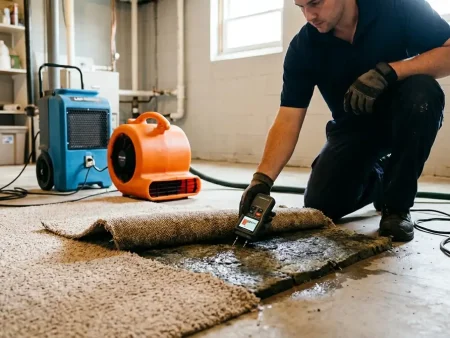
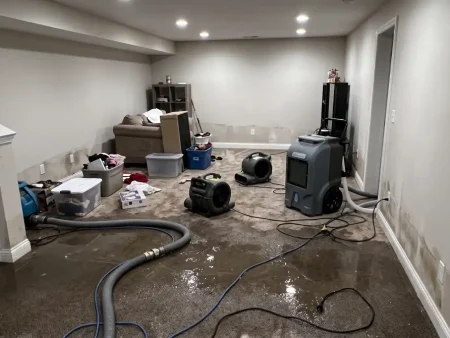
That’s why the gear matters. A shop vac and a box fan won’t cut it on a real flood. We use truck-mounted extraction to pull out as much water as possible up front (way more than any portable can), then set up commercial air movers and dehumidifiers and take moisture readings daily until the materials are actually dry, not just dry to the touch. Drywall that feels dry can still be wet inside. We check with meters, because guessing is how you end up with mold after water damage two weeks after you thought you were done.
Can the carpet be saved? Sometimes. With clean water caught early, we can often float the carpet, pull and toss the wet pad, dry the subfloor, then put down new pad and re-lay. With dirty water or a long delay, the carpet usually goes too. For more on drying times after normal cleaning (very different situation), see how long carpet takes to dry.
The scary part of any mold growth timeline is the stuff happening where you can’t look. Inside wall cavities. Under vinyl plank or laminate, which traps water against the subfloor like a lid. Under the kitchen sink base, where the cabinet bottom is particleboard and soaks up water like a cracker. Behind the washer.
Laminate’s the big one lately. People see the floor looks fine on top and figure they got lucky. Then three weeks later the boards start cupping and there’s a smell. So how fast does mold grow under a floating floor? About as fast as anywhere else. You just find out later.
If there was a lot of water, assume it got somewhere you can’t see, and check.
I get why people do it. Bleach kills stuff, right? On a hard, non-porous surface like tile or a countertop, sure. But on drywall, wood and carpet backing, bleach mostly whitens the surface while the water in it soaks deeper and feeds what’s underneath. The stain fades, the problem doesn’t.
Porous stuff with real growth on it usually needs to come out. Cut the drywall a couple feet above the water line, dry the studs, replace. Toss the pad. That’s how you actually beat mold after water damage, instead of just hiding it under a fresh coat of paint (which, by the way, buyers’ inspectors find).
This one gets missed a lot. If your furnace or air handler sits in the basement that flooded, or if water got into any ductwork, that system’s been pulling in damp air full of whatever’s growing down there. Once the space is dry, it’s smart to have the ducts looked at. We do air duct cleaning Baltimore MD jobs after floods pretty regularly, and that musty smell coming out of the vents upstairs is usually the giveaway.
Already past the window? Watch for these.
A musty, earthy smell that doesn’t go away. Spots or staining on drywall, especially near the floor. Baseboards that are swelling or pulling away. Paint bubbling. Carpet that stays damp or smells worse after it “dried.” Allergy-type symptoms that get worse in one part of the house. Any of those after a leak means someone should take a real look, because mold after water damage rarely stays small on its own. Get it checked with a moisture meter, not just a flashlight.
The faster somebody gets there, the smaller the job. Simple as that. That’s why being local matters on water calls. Our shop’s in Cockeysville, right off I-83, so for water damage restoration Cockeysville calls we’re often there quick. A lot of the split-levels and townhomes up here have finished lower levels with carpet, which is exactly where water goes first.
Further south, a lot of older rowhomes and basements in the city have been wet more than once, and those stone or block foundations hold moisture. Our water damage restoration Baltimore MD work in those houses is a lot of extraction, drying, and honestly some education about sump pumps and gutters.
A day or two to start. About a week to see it. That’s really the whole mold growth timeline in two sentences. If you’ve got water, don’t wait to see what happens. Pull the water, dry it hard, check it with a meter.
Extreme Carpet Cleaning LLC is family-owned, started by Shawn Mullikin in 1998. IICRC certified techs, truck-mounted extraction, and a 150% money-back guarantee on our cleaning and repair work. If the carpet can’t be saved, we do new carpet sales and carpet installation in Phoenix and all over the county, and installs come with a lifetime warranty.
If you’ve been sitting there wondering how long does it take for mold to grow after water damage while the basement is still wet, stop reading and get the water out. Got water right now? Call (410) 666-6600. Not an emergency yet? Request a free quote and we’ll walk you through it.


Tell us a little about your project. We’ll come out, take a look, and send you a written quote within one business day.