
Oriental Rug Cleaning: What a Professional Wash Actually Involves
October 23, 2026
☑️ 150% Money-Back Guarantee | Family Owned Since 1998
10815 Beaver Dam Rd Suite A, Cockeysville; MD 21030
☑️ Lifetime Warranty on Installations
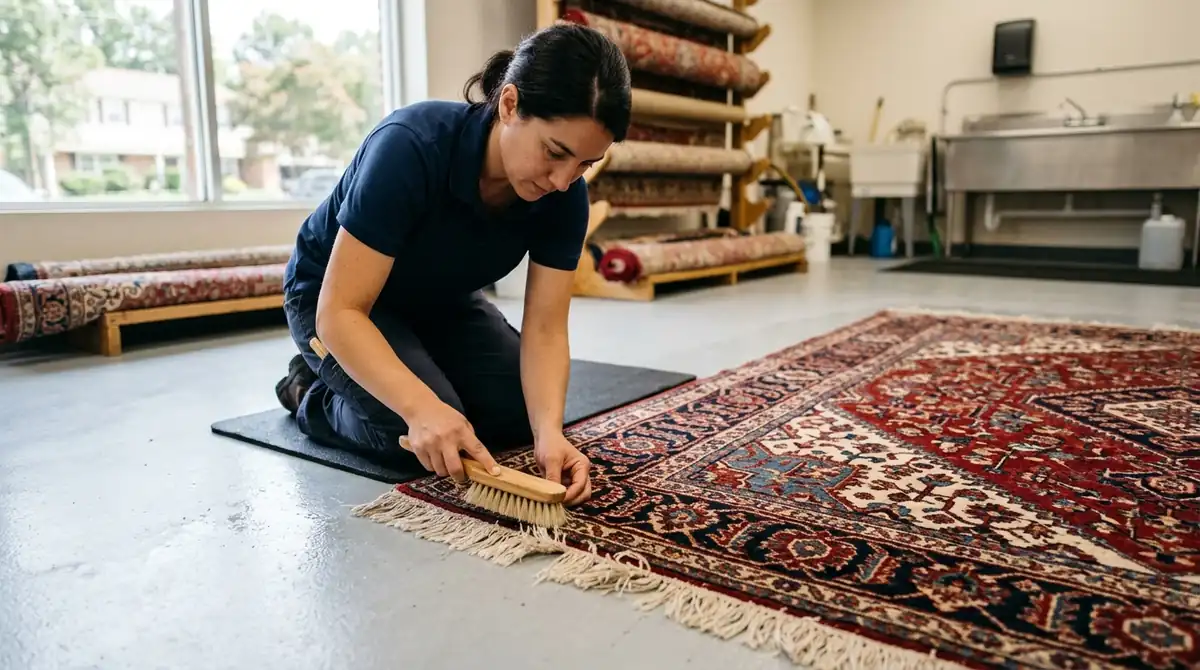
Half the rug calls we get start the same way. “It was my mother’s.” Red field, navy border, maybe a worn spot where a dining chair scooted back and forth for decades, and some neighbor has already suggested shampooing it on the driveway with a garden hose. Please don’t. Those blues will run into the ivory and they won’t run back. So let’s talk about what oriental rug cleaning really is, because it isn’t a carpet job with a smaller rug.
Quick background. I’m Shawn. My family’s run Extreme Carpet Cleaning LLC since 1998, and I’ve had my hands on a lot of wool, silk and some stuff I’d rather not identify. We’re WoolSafe approved and our guys are IICRC certified. None of that makes a rug clean by itself. What does is the boring stuff in the middle, which nobody ever sees.
Wall-to-wall carpet is mostly synthetic. Nylon, polyester, whatever. Hot water and the right rinse and it’s happy. A hand-knotted wool rug is a whole different animal (sometimes literally, there’s lanolin in that wool). Dyes? Could be vegetable, could be some 1970s synthetic that runs if you look at it funny, and nope, you can’t always tell from the front. Underneath you’ve got cotton or wool for the foundation. Cotton’s the troublemaker. Leave it wet too long and it shrinks, and it’ll wick brown junk up into the face like a coffee filter in reverse. Which is why hand knotted rug cleaning plays by its own rules.
So the first thing any decent outfit does for persian rug cleaning is look. Flip the rug over. Check the knots on the back, check the fringe, find out if the fringe is actually the warp threads (on a real hand-knotted piece it usually is) or something sewn on. Machine-made “Oriental style” rugs get handled a little differently than the real thing, and honestly a lot of folks don’t know which one they own until we turn it over on the floor.
Here’s the part that surprises people. A wool rug can hold an unbelievable amount of dry soil down at the base of the knots, sandy gritty stuff that grinds the fibers every time somebody walks across. Vacuuming gets the top. It doesn’t get the bottom.
So before any water touches it, the rug gets dusted. Beat, basically, from the back, until the grit quits falling out. That’s step one of oriental rug cleaning at our place, and it can take longer than the wash. Even a little 5×8 can drop a pile of grit on the floor that makes the owner go quiet for a second. “That was in my living room?” Yep. For years, probably.
Skip the dusting and wash a rug that dirty and you’re making mud inside the pile. Then you’re chasing brown lines for a week. Good oriental rug cleaners don’t skip it, and if somebody’s quoting you a price to clean your rug in your house in twenty minutes, ask them how they’re getting that grit out. (They’re not.)
Red bleeds. Any shop doing persian rug cleaning should know that by heart. Not always. But often enough that you test every color first, every time, with a damp white towel on each one. Some rugs are rock solid. Others, you touch the burgundy and it’s on the towel instantly, and that changes the whole plan. Cooler water, a different rinse, faster drying, sometimes a dye-setting step before anything else.
This is why I’m kind of a broken record about not scrubbing spills on a nice rug at home. You scrub a red-and-ivory Heriz with a hot soapy rag and you can give it pink clouds that are a lot harder to fix than the original spot. Blot. Cold water. Call. There’s a longer write-up on how to clean a wool rug if you want the do-it-yourself version, which is fine for little stuff.
OK, the actual wash. This is the meat of oriental rug cleaning, and it’s where a shop either knows wool or doesn’t.
The rug gets wet all the way through, front to back, with a wool-safe cleaner. Not carpet detergent from a jug. The point is to float the soil out of the knots without stripping the lanolin or pushing the pH somewhere the dyes don’t like. The WoolSafe folks are pretty strict about what qualifies, which is a big part of why we bothered to get approved.
Then rinse. And rinse again. If you’re interviewing oriental rug cleaners, ask how they rinse. Watch their face. Most of the problems I get called to fix on rugs other people cleaned come down to residue left behind. Sticky residue grabs dirt, and in a month the rug looks dingy again and the owner thinks wool just does that. It doesn’t.
Fringe gets its own attention. Cotton fringe yellows and goes gray, especially on rugs that get vacuumed with a beater bar that chews it up (please stop doing that, use suction only near the ends). Gentle hand work brightens it up. It won’t make 80-year-old fringe brand new. Fringe that’s already torn needs repair, not cleaning.
Then drying, which is honestly the part of hand knotted rug cleaning I care about most. A wool rug with a cotton foundation that sits wet is how you get browning, mildew smell, sometimes shrinkage. It needs airflow and it needs to dry fast and even. You can’t really do that on a living room floor with a fan pointed at it, which is the biggest reason we bring the good rugs back to the shop instead of cleaning them in place.
Pets. Yeah. Dog pee on wool is bad news, partly because urine can strip dye right out, and partly because the salts hang around in the foundation and stink again every muggy August afternoon. Spraying a deodorizer on top? Waste of a can. Real hand knotted rug cleaning for urine means flushing the foundation out from underneath. Sometimes you can save the look completely. Sometimes the smell comes out but a faded patch stays. I’ll tell you which one I think you’ve got before we start, not after.
Moths are the other thing. They love wool that’s dark, quiet and a little dirty, so think under the sofa, under the bed, or rolled up in a basement in Owings Mills since the kids left for college. Bare patches with a little silky webbing at the base of the pile, that’s moths. A proper oriental rug cleaning stops the party. It won’t grow the wool back.
Fair question. We clean plenty of rugs on-site, mostly synthetic ones or newer machine-made pieces that can take a lighter wash and dry quick. Nothing wrong with that. For the real wool and silk stuff though, I want it at the plant. You can’t dust a rug properly on your hardwood. You can’t flood the foundation and rinse it clean on your hardwood either (well, you can, once, and then you’re buying new hardwood).
So when somebody asks me for oriental rug cleaning in the house, I’ll usually come look first. If it’s a sturdy machine-made rug, fine, we’ll do it right there. If it’s Grandma’s Kashan, it’s coming for a ride. Any oriental rug cleaners worth calling back will say the same, smaller bill or not.
Most rugs in a normal house, every couple of years is fine. The front hall one, the rug that eats boots and dog paws and wet umbrellas all winter, yearly. That fancy dining room rug where the only traffic is Thanksgiving, you can stretch it. Silk’s a weird one though, and silk persian rug cleaning goes slower and pickier than wool, so budget the time. There’s a whole post on how often to clean area rugs if you want the breakdown by room.
Persian rug cleaning prices depend on size, fiber, condition, and whether there’s urine or fringe work involved, so I’m not going to throw a number at you here that won’t match your rug. We measure, look, and tell you. And our cleaning work’s covered by a 150% money-back guarantee, so if you’re not happy we’re not happy either.
The plastic thing especially. I’ve unwrapped rugs that went into storage “clean” and came out spotted with mildew. Wrap in breathable paper or cloth.
We grab rugs all over Baltimore County and the city. Some of the older homes we see for area rug cleaning Baltimore MD have rugs that came with the house, literally inherited along with the radiators. Up the I-83 corridor it’s more newer homes with big room-size pieces, and we do plenty of area rug cleaning Hunt Valley for families who finally pulled the 9×12 out of the basement.
Out on the west side of the county, we handle area rug cleaning Owings Mills MD pickups pretty regularly, a lot of them from townhouses where the rug is basically the whole living room. Closer to the shop, area rug cleaning Towson is a steady one, older colonials and rowhouses near York Road with heirloom pieces. And over in area rug cleaning Mays Chapel MD, it’s often silk-blend rugs that need an even gentler touch.
Redoing the floor under the rug while you’re at it? We also handle new carpet sales and carpet installation in Glen Arm and around the county, and every install comes with a lifetime warranty.
Look, a decent wool rug will probably be around after you and me both, and if it’s looked after it honestly gets softer and nicer with every decade. Throw it in the washer like a bath mat and you’ve trashed months of somebody’s hand knotting. So, yeah. Real oriental rug cleaning is slow on purpose. Hand knotted rug cleaning in general is. Dust first. Test the reds. Wash, rinse till the water’s clear, then get it dry quick.
Not sure what you’ve got, or worried about that pink spot by the sofa leg? Give us a call at (410) 666-6600 or request a free quote. Send a picture of the back of the rug if you can. That tells me more than the front.


Tell us a little about your project. We’ll come out, take a look, and send you a written quote within one business day.