
Best Carpet Padding: Thickness, Density and What to Skip
October 25, 2026
☑️ 150% Money-Back Guarantee | Family Owned Since 1998
10815 Beaver Dam Rd Suite A, Cockeysville; MD 21030
☑️ Lifetime Warranty on Installations
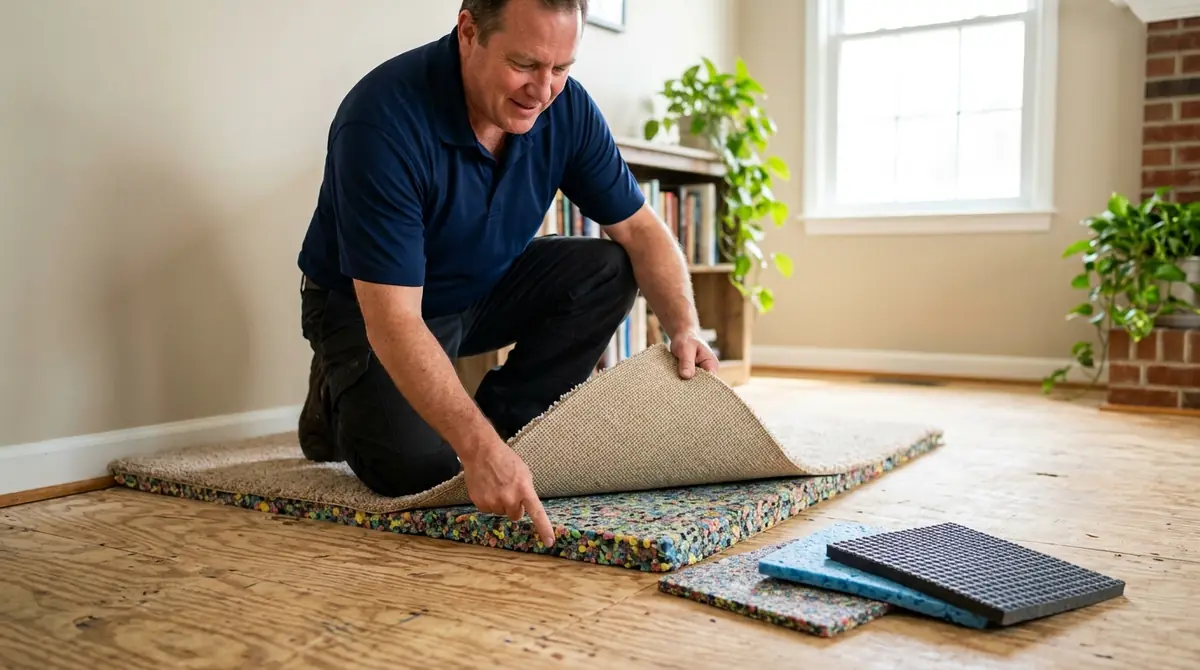
I’ll start with the unpopular opinion. The squishiest pad in the store is usually the wrong one. Everybody wants to sink into it like a mattress, the salesperson knows it, and so the thick stuff gets the nice display by the door. But the best carpet padding for most homes is thinner and firmer than people expect. I’ve been cleaning, repairing and installing carpet around here since 1998, and a lot of the stretching and seam repair work we do traces right back to a pad that was too soft.
So. Let’s talk pad.
Pad isn’t mostly about comfort, even though that’s how it’s sold. It’s a shock absorber for the carpet. Think about your sneakers. Hard pad, no give, the carpet fibers get pounded flat between your heel and the subfloor. Mushy pad, and now the backing’s bending like a trampoline every time your teenager stomps down the hall, and one day you notice a wave by the closet door and a seam that’s started to grin at you.
Yeah, it keeps the room a little warmer, and it’s why a lot of folks can’t hear the kids clomping around upstairs at 5 a.m. Bonus stuff. Support is the job.
Here’s where folks go wrong. Carpet pad thickness gets all the attention because you can see it and feel it. Half an inch sounds better than 7/16. Right?
Nope. Under your average cut pile in a house, 7/16″ and you’re good, and if you dig into what the Carpet and Rug Institute puts out, that’s about where their ceiling sits for most of it too. Berber’s a whole other deal. Loops, low-profile stuff, the skinny commercial-looking carpets, you want 3/8″ tops, firm as a gym mat. Put berber on a fat squishy pad, ignore the carpet pad thickness printed right on the warranty sheet, and give it a year. I’ve pulled up berber that looked like ocean waves after a couple of years. Every time, pad.
And here’s a kicker most people don’t know. A lot of carpet warranties spell out what pad you need. Put the wrong carpet pad thickness under it, and if something goes wrong, the carpet maker can say no. Not fun to find out later.
Carpet padding density is measured in pounds per cubic foot. You’ll see 6 lb, 8 lb, 10 lb and so on, mostly on rebond pad. Higher number, firmer and more durable, and it holds up longer without flattening out.
For a bedroom that gets light traffic, a 6 lb rebond can do fine. For living rooms, hallways and stairs, I’d go 8 lb at least. Stairs especially, because the nose of each step gets hammered and a soft pad just collapses there. Loop carpet wants the firmer end too.
If you’re comparing two pads and one’s thicker and one’s denser, honestly, go denser. A thinner, denser pad will outlast a thick, fluffy one nearly every time. That’s the single best tip I’ve got on carpet padding density, and it isn’t on most sample tags.
The multicolored one, made from bonded scraps of foam. Most common pad out there, good value, comes in a range of densities. For most homes, a decent rebond is the best carpet padding for the money. Nothing fancy about it.
Feels amazing. Really soft, kind of like stepping on a bed. A memory foam carpet pad is popular in bedrooms for exactly that reason. Thing is, soft means more flex, so it’s not what I’d want under loop carpet or in a hallway, and some of them are pretty thick. Guest room with a plush on top that says it’s OK? Go nuts.
Slab rubber weighs a ton (my guys groan when they see it on the order) and it pretty much never dies. You pay for that. Waffle rubber (the bumpy kind) looks plush but the bumps compress over time, and I’m not a fan in most homes.
Firm, flat, and made for berber and commercial carpets. Not cozy, but it does the job loop carpet needs.
These have a film on top that keeps spills from soaking down into the pad. If you have pets, or kids with juice cups, I’d seriously look at one. Once urine gets into a regular pad it’s a sponge, and cleaning the top of the carpet can’t reach it. My post on the best carpet for pets goes deeper on this.
You know the move. Take your shoes off, stand on the sample, wiggle your toes. Everybody does it. I do it too.
Problem is, a sample is a two-foot square sitting on a hard showroom floor, and you’re standing still. At home you’re walking, turning, dragging a dining chair, the kids are jumping off the couch, and the carpet’s stretched wall to wall over a subfloor that’s maybe not perfectly flat. That soft feeling in the store is exactly the flex that loosens carpet over time.
Do this instead, and yes the salesperson will look at you funny. Ask for a scrap of just the pad. Jam your thumb in it like you’re checking a cantaloupe. If the dent hangs around and slowly fills back in, that’s cheap low-density stuff. Pops right back? Good. And ask what the density number is. If the salesperson doesn’t know, that tells you something too.
One more thing to ask about is what’s under the pad. Wood subfloor, concrete, old vinyl? It changes what the best carpet padding is for that room, and a good installer will ask before you do.
A few questions I’d have on a sticky note at the store:
That last one matters. Some quotes look cheap until you notice the pad line is the bargain stuff. Compare quotes apples to apples, same carpet padding density, same thickness.
Concrete basements are their own thing. They can wick moisture up from below, so you want a pad that won’t hold water or grow funk, like a synthetic fiber pad or a rubber or foam with a moisture barrier. Run a dehumidifier. If the basement has flooded before, think hard about whether carpet’s the right floor at all. We do water damage restoration too, and wet basement pad almost always has to come out.
Stairs, as I said, firm and dense. A thick memory foam carpet pad on stairs feels mushy underfoot and the carpet wears through at the nose way sooner.
Rooms with radiant floor heat need a thinner pad so heat can get through. Ask about that if you’ve got it.
If your carpet’s rippling, there’s a real good chance the pad is part of it. Soft pad plus heavy furniture plus Maryland humidity, the carpet stretches and doesn’t come back. We fix that with power stretching, but stretching over a worn-out pad is a short-term fix. I wrote about why carpet ripples if you want the long version.
Pad matters for cleaning too. A firm pad lets our truck-mounted wand pull water back up better. A soft, thick, saturated pad holds more moisture and the carpet can take longer to dry.
A lot of places, honestly. In the newer developments off York Road, builder-grade carpet over builder-grade pad is pretty standard, and around year five the hallways start looking tired. When people call us for carpet installation Cockeysville, one of the first things I ask is what’s under the old stuff, because we’ll usually find a thin, low-density rebond that’s flattened out to nothing.
Older homes are another story. Down by the university, half the carpet installation Towson MD jobs we get are in houses from the ’50s with subfloors that dip a bit here and there, and a firm pad bridges those little dips where a soft one just sags right into them.
Up in the corporate-park end of things, carpet installation Hunt Valley can be anything from a townhouse bedroom to an office floor, and the office stuff almost always wants a thin, dense pad or glue-down. And yes, we do go further out for installs. Folks have asked about carpet installation Annapolis MD, and the pad advice down there’s no different. Boat shoes still wear out cheap pad.
If you asked me in the driveway what the best carpet padding is for a normal family home with cut pile carpet, here’s what I’d say:
A memory foam carpet pad in a master bedroom? Sure, if the carpet allows it. Under the family room sectional where the dog naps? No. That’s where carpet padding density wins over softness.
And don’t reuse old pad. Ever. It’s already flat, it’s probably dirty, and it can void the new carpet’s warranty. Saving a few bucks on pad under a brand new carpet is like buying good tires and keeping bald ones on the back. If your carpet’s already struggling, my post on whether to repair or replace carpet might help you decide.
Extreme Carpet Cleaning LLC has been family-owned since 1998, shop’s in Cockeysville. We do new carpet sales and carpet installation in Carney and around the county, and every install comes with a lifetime warranty. Pad included in the conversation, always. Our cleaning and repair work is backed by a 150% money-back guarantee, and our techs are IICRC certified.
Want to see samples in your own living room light, with a couple pads sitting next to them so you can do the thumb thing? Give us a ring at (410) 666-6600, or just request a free quote online if you hate phones (lots of people do). Bring your questions about carpet pad thickness. I’ve got opinions.


Tell us a little about your project. We’ll come out, take a look, and send you a written quote within one business day.