
Why Is My Carpet Rippling? A Carpet Guy’s Straight Answer
October 21, 2026
☑️ 150% Money-Back Guarantee | Family Owned Since 1998
10815 Beaver Dam Rd Suite A, Cockeysville; MD 21030
☑️ Lifetime Warranty on Installations

Somebody calls the shop about once a week and the first thing out of their mouth is some version of why is my carpet rippling, usually followed by “it wasn’t like this when we moved in.” I’m Shawn. I’ve been running Extreme Carpet Cleaning LLC out of Cockeysville since 1998, and I’ve walked on more lumpy wall-to-wall than I’d like to admit. So here’s the plain version of what’s going on under your feet and what actually fixes it.
A ripple is just slack. That’s it. Wall-to-wall carpet is held down around the edges of the room by tack strip, those skinny wood strips with little angled pins sticking up. When it went in, the carpet was (supposed to be) pulled tight across the room and hooked onto those pins. If the carpet ends up even a hair bigger than the room, or the edges let go, the extra material has nowhere to go but up. Waves. Humps. That long wrinkle running from the doorway to the couch that you keep catching your toe on at 2 a.m.
Some people call it carpet buckling, some call it bubbles. Same animal. And no, it won’t fix itself, even if it seems to flatten out every winter. I’ll get to why. The Carpet and Rug Institute installation standard actually calls for power stretching, which tells you something.
There are maybe five things that cause it, and in a lot of houses it’s two or three of them piling up.
This is the big one. If I had to guess blind, I’d guess this every time. Plenty of installers do a whole room with a knee kicker because it’s quick. A knee kicker is fine for snugging carpet onto the strip along a wall, but it can’t put real tension across a 14-foot living room. You need a power stretcher for that, a long telescoping pole that braces on the opposite wall and lets you pull the carpet tight in a way your knee never will.
Skip that step and the carpet looks great for a year, maybe two. Then it relaxes. Honestly, that’s the root of most carpet buckling I see in houses under ten years old. We get called to newer builds where the carpet’s three years old and already looks like a pond on a windy day, and that’s a big chunk of the carpet repair over in Owings Mills we do.
Carpet backing pulls moisture out of the air. When it’s sticky in July and the AC is losing the fight, the backing swells a little and loosens. A lot of folks notice the waves show up in August and kind of disappear around Christmas once the furnace dries everything out. That seasonal back and forth is a pretty good tell that the carpet was a little loose from day one. A tight install shrugs off humidity. A loose one shows every bit of it, and seasonal carpet rippling is usually the first sign.
Basements are the worst. I see it constantly in older stone and block foundations where the lower level just stays damp, the kind of thing we deal with doing carpet repair in Glen Arm and on jobs for Hydes carpet repair customers with finished basements.
Pad matters more than people think. Too thick and squishy and the carpet flexes every time somebody steps on it, which works the backing loose over time. Too thin, or so old it’s crumbling into that orange dust you’ve probably seen when you pull up a corner, and you get the same result from the other direction. Most residential carpet wants a firm pad somewhere around 7/16 inch, and the carpet maker usually says what they’ll accept. If somebody put an inch-thick plush pad under a berber because it “felt nicer,” that berber’s going to wrinkle. Bet on it.
Sliding a loaded bookcase or a sleeper sofa across the room shoves the carpet ahead of it, same as pushing a rug on a wood floor. Do that a few times and you’ve popped the far edge right off the tack strip. Furniture dragging causes more carpet buckling than people realize. Lift, don’t drag. Or get some furniture sliders and push slow.
Here’s the one I’m a little touchy about. When carpet gets soaked and stays wet for a long time, the backing can loosen and even delaminate (the secondary backing separates from the primary one). Rental machines and some bargain “steam cleaning” outfits dump way too much water down and don’t pull nearly enough back out. Then it sits wet for two days.
Three. Our truck-mounted units run water at around 212°F with serious suction behind them, so most carpets are dry in a few hours. I wrote a longer piece on how long carpet should take to dry if you want the details. Anything past a day and a half and you’re flirting with mildew too, since mold likes that 24 to 48 hour window.
Yes. And not just because it looks sloppy.
A ripple is a trip hazard first. Grandparents, toddlers, anybody hauling a laundry basket down the hall in socks. Second, every time you walk across a hump it gets creased and scuffed harder than the flat carpet around it, so that’s where the backing cracks and the pile wears into a shiny line. Leave it long enough and the crease can stay even after it’s stretched (not always, but it happens). Vacuums hate it too. The beater bar grabs the wave and chews on it.
So I’d deal with carpet rippling sooner rather than later. A stretch is a small job. A torn seam from two years of feet catching a hump is a bigger one.
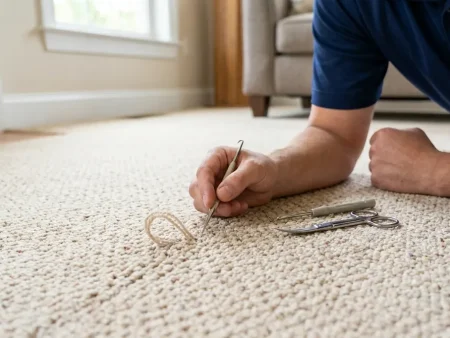
I’ve seen every one of these home attempts to fix carpet ripples, some more than once.
The problem is extra material, so the only real way to fix carpet ripples is to take that slack out and lock the carpet back onto the strip, tight.
Power stretching is the only way I know to fix carpet ripples so they stay fixed. When my guys come out for a ripple job, here’s roughly how it goes. We move whatever furniture needs moving (we’ll handle the big stuff, but clear the knick-knacks off shelves for us). Then we release the carpet from the tack strip along one or two walls, check the strip and pad, and replace any strip that’s rotted or lost its pins.
Then the stretcher goes down. We brace it on the far wall, set the head a few inches from the wall we’re pulling toward, and walk the carpet tight in sections across the whole room. Once it’s snug we hook it back onto the pins, trim the extra, and tuck the edge into the gap at the baseboard.
A normal bedroom takes well under an hour. A big open family room with a seam through the middle takes longer, because we’ve got to be careful not to stress that seam. You can walk on it as soon as we pack up. No drying, no smell, no waiting around.
We do this all over our end of Baltimore County. Lately it’s been a split-level near York Road with carpet repair in Towson, a farmhouse with a 30-foot family room for our Monkton repair crew, and a couple of condos where we handled Mays Chapel carpet stretching in one afternoon.
Most can. If the backing has badly delaminated, though, stretching just pulls the face fibers away from a mushy backing and it ripples again. Same if the carpet is 20 years old and brittle. In those cases I’ll tell you straight that it might be time to replace it, and I’ve got a whole post on whether to repair or replace carpet.
If it does need to go, we handle new carpet sales and carpet installation in Cockeysville and the surrounding towns, and every install comes with a lifetime warranty. We power stretch every room we put in, so the ripple doesn’t come back to haunt you.
Fair question, and I hear it. Somebody gets their carpet cleaned and a week later there’s a wave in the hallway. Did the cleaner cause that carpet rippling? Sometimes, yeah. Overwetting can loosen backing like I said. More often, though, the carpet was already loose and the moisture just let it relax enough for you to notice.
A good cleaner should point out loose carpet before starting. We do. If one of my techs spots carpet buckling in a room we’re cleaning, he’ll show you and you can decide if you want it stretched the same visit. Cleaning first and stretching right after usually works out best, honestly, because the fibers are fresh and the carpet lays down nice and even.
Our cleaning is done by IICRC certified techs and backed by a 150% money-back guarantee, so if something we did caused a problem, we fix it. The lifetime warranty is for installs only, just so nobody’s confused.
None of this is complicated.
That’s pretty much it. Carpet isn’t fussy if it went in tight. If you catch a small wave early, it’s a lot cheaper to fix carpet ripples now than to patch a worn crease later. A little carpet rippling near a doorway is the easiest kind to deal with anyway.
We’re at the shop on Beaver Dam Road, so carpet repair in Cockeysville is a big part of any given week. Up the I-83 corridor we’re regularly doing Hunt Valley carpet repair, Sparks Glencoe carpet stretching, and carpet repair up in Hereford.
Closer to the Beltway we’re in and out of houses for Stevenson carpet repair all the time, and we cover carpet repair around Phoenix too. Our Baltimore carpet repair page has the rest.
If you’re standing in your hallway right now staring at a hump and asking yourself why is my carpet rippling, give us a call at (410) 666-6600 or request a free quote. Snap a photo if you can. Half the time I can tell you what’s going on from the picture alone.



Tell us a little about your project. We’ll come out, take a look, and send you a written quote within one business day.