
How to Fix a Snag in Carpet Before It Turns Into a Run
October 24, 2026
☑️ 150% Money-Back Guarantee | Family Owned Since 1998
10815 Beaver Dam Rd Suite A, Cockeysville; MD 21030
☑️ Lifetime Warranty on Installations
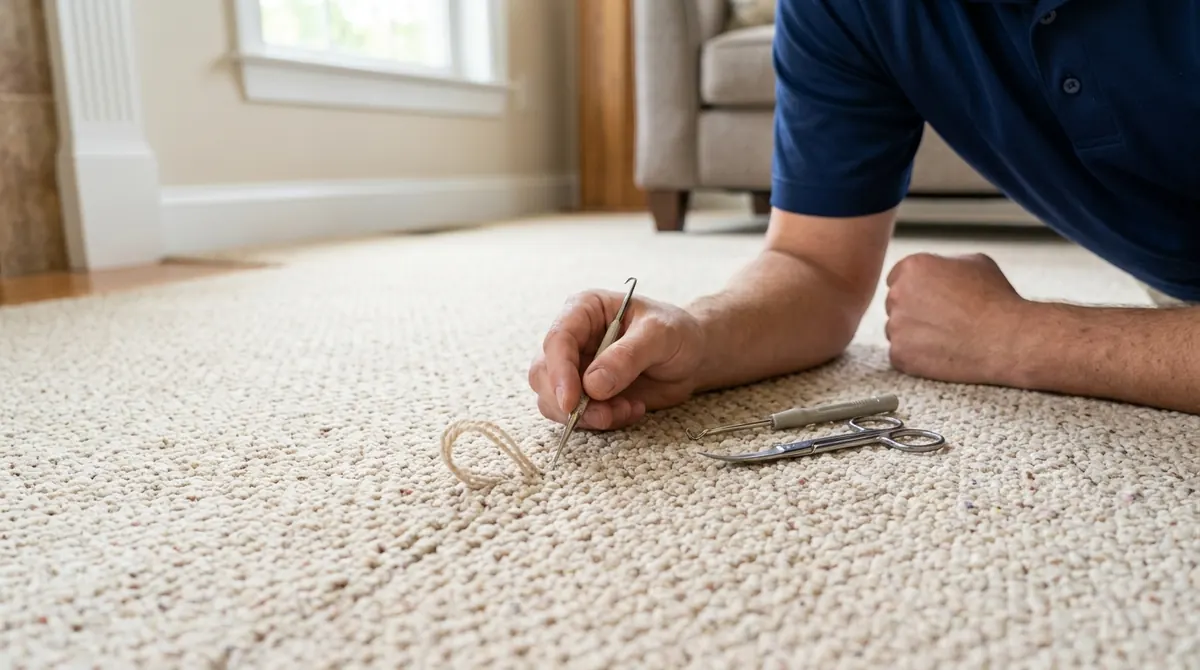
Don’t pull it. I mean it. Put your hand down. I know. It’s sticking up there and it’s driving you nuts and you want to yank it like a loose thread on a sweater. People who do that end up calling me about a run from the couch clear to the bathroom door, usually on Berber that’s barely a year old. So here’s how to fix a snag in carpet the way my guys would on a service call, plus my honest take on which ones are a Saturday job for you and which ones aren’t.
Some background on me. I’ve been fixing, stretching, cleaning and installing carpet around here since 1998. I’ve seen snags caused by cats, dogs, kids, vacuums, a toddler’s push toy, and (no joke, this is horse country) riding boots with spurs. Most of them are easy. A few are not.
Get down and look at the carpet near the snag. Not the snag itself, the carpet around it.
If the tops of the yarn are cut, like little brush bristles, you’ve got cut pile. Plush, frieze, saxony, that kind of thing. Good news! Cut pile is basically a bunch of little separate tufts stuck in the backing, none of them holding hands, so a carpet snag there pretty much stays put. Snip it, go watch the Ravens.
If the yarn goes up and back down in little loops, that’s loop pile. Berber, level loop, a lot of commercial style carpet. This is the one that runs. Every loop is connected to the next one in the row, kind of like knitting. Pull one and you’re pulling the whole line out of the backing.
Go raid the bathroom drawer for the little cuticle scissors, or the sewing kit if somebody in the house sews (cuticle ones are honestly better, the tips are sharper). Pinch the strand between two fingers, lift it just enough to see it, and snip it off even with the stuff around it. Not a millimeter lower.
Don’t cut below the surface. You’ll leave a little bald spot. Level with the neighbors is the goal. If it’s a bunch of fuzzy, sprouted tufts in one spot, the kind you get from a vacuum beater bar, trim them all the same way and then vacuum.
Honestly that’s 80 percent of the calls where someone asks me how to fix a snag in carpet. Scissors, thirty seconds, and I just saved you a service call fee. Keep that between us.
Okay. Loop pile. This is where people make it worse.
A single pulled loop that’s sticking up a little higher than the rest? You can often trim it flush, same as cut pile. The tuft is still anchored in the backing on each side, so snipping the top off usually just leaves a cut tuft that blends in. Look really close. Is it one loop? Or is there a line of loops that are lower than the rest, leading up to it? If it’s a line, that’s a run already started, and trimming the top won’t stop it.
For a short run, maybe an inch or two, you can tuck it back in. Here’s how.
Don’t use super glue. It gets hard and crunchy and turns dark. Don’t glob it on either. You want just enough to hold the yarn to the backing.
It won’t be invisible. It’ll be pretty close. Most people can’t find it a month later.
Berber carpet repair comes up all the time for us, more than any other style honestly. People buy berber because it’s tough and hides dirt, which is true. Then a cat finds it. Cat claws and berber loops are just a bad combo (it’s the single biggest source of berber carpet repair calls we get), and there’s no training your way out of it.
If a run on berber is long, more than a few inches, or there are several of them, tucking gets messy. That’s when we usually do a patch. We cut out the damaged piece, cut a matching piece from a closet or leftover scrap, and bond it in with seam tape and a heat iron. Done right, with the pattern lined up and the direction of the pile matching, it’s really hard to spot.
Save your scraps, by the way. If your installer left a piece in the garage, that’s gold for future berber carpet repair. If not, we can sometimes pull from inside a closet and put something less visible back there.
Worth figuring out, or you’ll be doing this again next month.
Vacuums are a big one. A beater bar on high, especially on loop carpet, can grab yarn and fuzz it right up. Turn the brush off or raise the height for berber. Pets are the other big one. Clip those nails. And loose carpet. Loose carpet kind of shuffles under your feet every step, and after a few years of that the seams and edges give up and start letting go. A carpet snag right next to a ripple isn’t a coincidence. I wrote more on that in why carpet ripples, and power stretching usually solves it.
Doorways and seams get it too. Where carpet meets tile or hardwood, the edge takes a beating. If a seam is splitting open and yarn is coming loose along it, glue won’t hold forever. That needs to be re-seamed.
I’ll just list my pet peeves. Short version.
Yanking the loose strand. Cutting below the pile and leaving a pit. Super glue. Duct tape on the back (it lets go, and then there’s sticky gunk in your pad). Ignoring it for six months while the dog makes it longer. And my favorite, trying to fix a run by burning the end of the yarn with a lighter. Please don’t. Nylon melts into a hard little bead, wool just stinks, and you can scorch the carpet around it.
Also, if you’re thinking about just replacing the room, read my take on repair or replace carpet first. Most snags don’t come close to needing new carpet.
If you’ve tried the tuck-and-glue and it’s still coming apart, or the run is longer than your hand, or there’s a pulled loop right on a seam, call. Same if it’s in a main walkway where it’ll get hit every day. Those don’t hold up long as DIY fixes.
We do a lot of these. A good chunk of our carpet repair Hunt Valley MD work is berber in finished basements, where the kids’ playroom and the cat’s favorite scratching spot are the same room. In the condos and townhomes over in Mays Chapel, it’s mostly snags at doorways and seams on newer loop carpet. Folks there can check our carpet repair Mays Chapel page.
Up in the bigger houses around Phoenix and Sparks Glencoe, we see more patching jobs, often on stairs where a dog’s claws catch the nose of every step. A run on a stair nose is tough to tuck. Patching or re-wrapping that step is usually the better fix. For those areas, see carpet repair Phoenix MD and carpet repair Sparks Glencoe.
Stevenson has a lot of older homes with carpet from twenty years back, and that old loop carpet gets brittle and runs easy. Sometimes we patch, sometimes we tell people it’s time. Honestly it depends on the room. Here’s our carpet repair Stevenson MD info. Same story down in Towson with rentals and student houses, where a carpet snag gets ignored until move-out day and the landlord calls us in a panic. That’s what carpet repair Towson is for.
People always ask what a repair visit actually looks like, so here goes. We show up, look at the carpet snag, and usually check the rest of the room too, because if there’s one there’s often two. Then we figure out whether it’s a tuck, a re-seam, a stretch or a patch.
A tuck job is quick. A patch takes longer, because finding a donor piece and matching the pile direction is fussy work. If the carpet’s loose, we’ll power stretch it first, otherwise the repair just gets pulled apart again the next time someone drags a chair across it. Stairs take the longest. Every step is its own little project.
For berber carpet repair on a big run, I’d rather patch than tuck. Tucking a long run means hundreds of loops pushed back by hand, and each one has to sit at the same height. A patch is cleaner. A pulled loop here and there, though? Tuck it. No sense cutting a hole in your floor for one loop.
And yeah, sometimes we clean the area too while we’re there. A fresh patch next to dingy carpet stands out, so a quick cleaning helps it blend.
If you’re replacing anyway and you have pets, think hard before you go loop. Cut pile is way more forgiving. The Carpet and Rug Institute has some useful general info on carpet styles if you want to read up. We also do new carpet sales and carpet installation in Glyndon and across Baltimore County, and every install comes with a lifetime warranty.
So, how to fix a snag in carpet, in one breath. Figure out if it’s cut or loop. Cut pile, trim it level. Single pulled loop, trim it level. A run, tuck it back with a little seam glue. Long runs, seams, stairs, or berber with lots of damage, get it patched. And whatever you do, don’t pull.
Still not sure how to fix a snag in carpet you’re staring at right now? Snap a picture and send it over. Extreme Carpet Cleaning LLC is family-owned since 1998, our repairs are backed by a 150% money-back guarantee, and we’re right in Cockeysville. Call (410) 666-6600 or request a free quote.




Tell us a little about your project. We’ll come out, take a look, and send you a written quote within one business day.