
Handmade vs Machine Made Rug: How to Tell the Difference
October 24, 2026
☑️ 150% Money-Back Guarantee | Family Owned Since 1998
10815 Beaver Dam Rd Suite A, Cockeysville; MD 21030
☑️ Lifetime Warranty on Installations
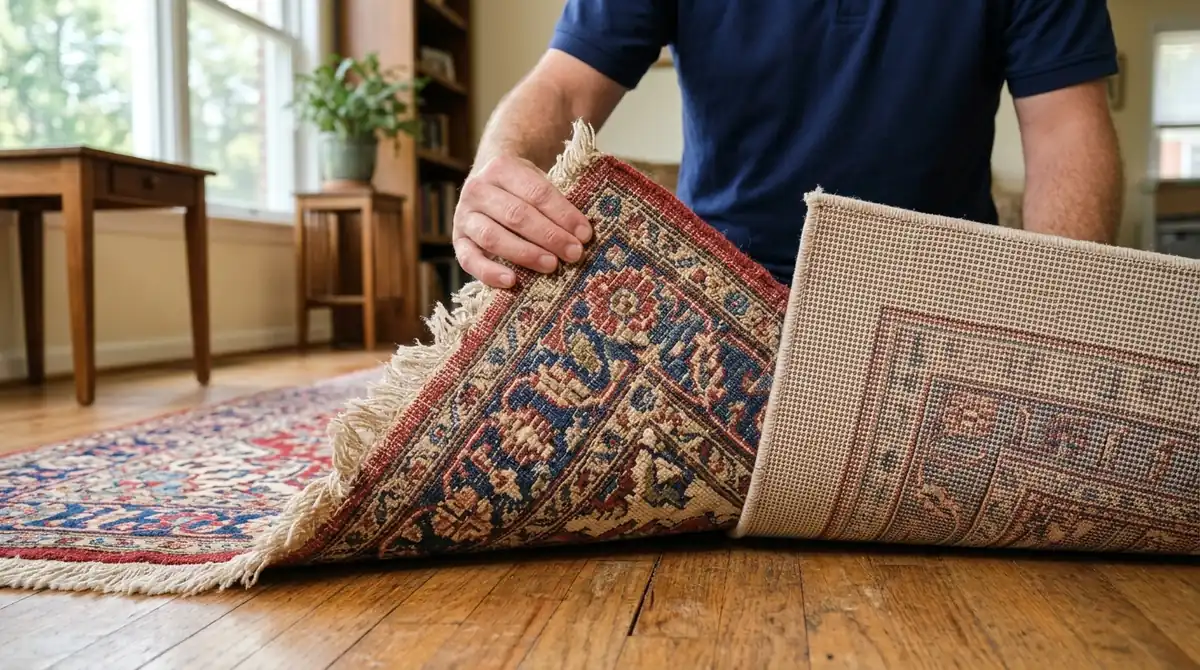
First thing I do when I walk into a house for a rug job? I get down on my knees and flip the corner over. Every time. People think I’m checking for stains or bugs, and sometimes I am, but mostly I’m answering the handmade vs machine made rug question before anybody hands me a story about where it came from. The back of a rug doesn’t lie. The tag sometimes does (and the guy at the estate sale definitely does).
Why should you care? Because the two get cleaned differently. Different water temps, different drying, different tolerance for chemistry. Get it wrong and you can bleed the reds into the ivory field, or shrink one end so the thing never lays flat again. I’ve been doing rugs since the late 90s and I’ve seen both happen, usually after a well-meaning homeowner went at it with a rental machine.
Go do it. I’ll wait.
On a hand-knotted rug, the back looks almost like the front. You’ll see the same pattern, a little blurrier, and you’ll see tiny individual knots in rows. Look close and they’re not perfect. Some rows wander. A flower on the left might be a hair fatter than its twin on the right. That’s a person, not a computer, and honestly it’s the best part.
A machine-made rug usually has a back that’s super uniform. Dead straight lines, every stitch the same size, kind of like graph paper. Sometimes there’s a stiff white or tan backing glued on, or a grid of thread you can see through the pile. If it looks perfect, it probably came off a power loom.
There’s a third kind, and it’s the one that causes the most confusion. Hand-tufted rugs are made by a person with a tufting gun punching yarn through a canvas, then a layer of latex glue and a cloth backing goes on the back to hold it all in. So yes, a human made it. But it’s not knotted. If your rug has a felt or canvas cloth on the back that you could peel at the corner, it’s tufted. Those are their own animal when it comes to cleaning, and I’ll get to why in a minute.
Here’s a quick trick for how to tell if a rug is handmade. Look at the fringe. On a real handmade piece, the fringe is the warp, meaning those are the actual threads the whole rug was woven on. They run the full length of the rug and come out both ends. You can’t take them off without the rug falling apart.
On a machine rug, the fringe is usually sewn on after. Fold back the end and you’ll often see a strip of fabric or a line of stitching where somebody attached it. Same goes for a lot of tufted rugs. Fake fringe is kind of a giveaway, and it’s also the first thing to tear loose in a cleaning plant if nobody’s careful with it.
Sides tell you stuff too. Handmade rugs have sides wrapped by hand, called the selvedge, and it’s a little lumpy and uneven. Machine rugs get a serged edge that’s neat and tight and identical all the way down. If it looks like the hem on a store-bought towel, well.
Not everybody wants to sit on the floor squinting at knots. Fair. So here’s the short version I give people on the phone when they’re trying to describe a rug to me:
None of this is a hundred percent. I’ve seen some old machine-woven wool pieces from the mid-century that are honestly nicer than a cheap handmade rug. And there are handmade rugs out there with sloppy work. The handmade vs machine made rug debate isn’t really about which one is “better.” It’s about what’s in your living room so you know how to treat it.
OK so this is where the handmade vs machine made rug thing actually hits my job.
Most hand-knotted rugs I see are wool, sometimes with cotton foundation, sometimes silk accents. Wool is tough stuff. It holds up great. But it doesn’t love high heat or harsh, high-pH cleaners, and the dyes on some older or cheaper handmade pieces aren’t fully set. Hit them with the wrong product and the colors run. We’re WoolSafe approved, and the WoolSafe folks have a whole list of cleaning products that are safe on wool for exactly this reason.
A hand-knotted rug usually comes to our plant. We dust it out first (you would not believe what comes out of a rug that’s been in a dining room for 20 years, it’s mostly sand and it’s kind of gross), then wash it on the floor, rinse it really well, and hang it to dry with airflow. Rinse matters. Soap left in wool turns into a dirt magnet.
Tufted rugs we handle carefully because of that latex layer. Too much water and the glue can break down, the backing separates, and sometimes you get this sour smell like old rubber. Not fun. Low moisture, fast drying.
A machine-made rug, especially the synthetic ones, is the easy patient. Polypropylene and nylon can take hotter water and stronger spotting. A lot of those we can do right in your house with the truck, same as wall-to-wall. Poly does hold oily soil though, so the traffic lane in front of the couch sometimes stays a little gray. That’s the fiber, not us.
Honestly the worst damage I see is from DIY. People rent a machine, flood a wool rug, leave it wet on hardwood overnight, and now there’s a stain on the rug AND a cupped board underneath. If you want to try a light touch-up yourself, my walkthrough on how to clean a wool rug covers what’s safe and what isn’t.
Usually, yeah. A decent hand-knotted rug can last for generations if it’s cleaned right and kept off a damp basement floor. People hand them down. A machine-made rug is more like furniture you’ll replace someday. Nothing wrong with that at all. Plenty of folks with little kids and a big dog pick a machine-made rug on purpose, honestly, so they can sleep at night.
But it does change how much risk I’m willing to take in cleaning, and how much I’d spend repairing one. Rebinding a frayed edge on a nice handmade piece? Worth it. On a 5×8 poly rug from a big box store? Probably not, and I’ll tell you that straight.
When folks ask me how to tell if a rug is handmade because they’re wondering about selling it, I tell them I’m a cleaner, not an appraiser. I can tell you how it was made. What it’s worth is a different conversation with a different guy.
Rugs follow the houses. In the bigger older homes up around Monkton and Hereford we see a lot of inherited Persian and Turkish style rugs, real wool, real knots, sometimes with old moth damage hiding under a sofa. A hand-knotted rug like that almost always comes to the plant. We do a fair amount of area rug cleaning Monkton for exactly those horse-country farmhouses, where the rug’s been dragged in mud for years by boots and dogs.
Closer to home, the townhouses and newer builds tend to have a machine-made rug on top of carpet or LVP. Totally different job. Our shop is on Beaver Dam Road, so a lot of area rug cleaning Cockeysville MD customers just drop the rug off themselves, which is easier for everybody.
Stevenson is kind of a mix. Big old houses, some real heirloom pieces, and also a lot of tufted rugs bought in the last ten years that look expensive but have that latex back. We get calls there all the time from people who’d swear on a stack of bibles it’s a hand-knotted rug. Flip it over? Canvas backing. Happens constantly and it’s no knock on anybody, tufted just gets cleaned a different way, and done right it comes out great. If you’re nearby, our area rug cleaning Stevenson page has the details.
Out in Glen Arm and Baldwin you get more of the rustic stuff. Braided rugs, flatweaves, kilims. Kilims are handmade too, just flat woven without pile, and they’re often more fragile than they look. Folks out that way can check area rug cleaning Glen Arm MD for pickup info.
Depends on traffic more than type. A rug in a front hall with kids and a dog might need cleaning every year. A rug in a formal room nobody uses (we all have one) can go three or four. I wrote more about timing in how often to clean area rugs if you want the long version.
One tip that helps any rug, no matter how it was made. Rotate it every six months or so. Sun fades one side, foot traffic wears one end. Turning it evens that out. Also vacuum the back once in a while. Grit works its way through and grinds at the foundation from underneath. Weird but true.
Sometimes the honest answer is the rug’s done. Moth eaten, dry rotted from a flood, pet urine through the foundation for years. It happens. When people are redoing the whole room we also handle new carpet sales and carpet installation in Stevenson and around the county, and every install comes with a lifetime warranty. Carpet underneath, nice rug on top, it’s a good look.
If you can’t figure out which kind you have, just send me a photo of the back and the fringe. Takes me two seconds. Still stumped on how to tell if a rug is handmade? That’s what we’re here for.
Extreme Carpet Cleaning LLC has been family-owned since 1998, our techs are IICRC certified, and rug cleaning is covered by our 150% money-back guarantee. Call (410) 666-6600 or request a free quote and tell us what’s on the floor. Or just flip that corner first. You’ll probably know before you even call.


Tell us a little about your project. We’ll come out, take a look, and send you a written quote within one business day.