
How to Patch Carpet: Burns, Pet Damage and Holes
October 26, 2026
☑️ 150% Money-Back Guarantee | Family Owned Since 1998
10815 Beaver Dam Rd Suite A, Cockeysville; MD 21030
☑️ Lifetime Warranty on Installations
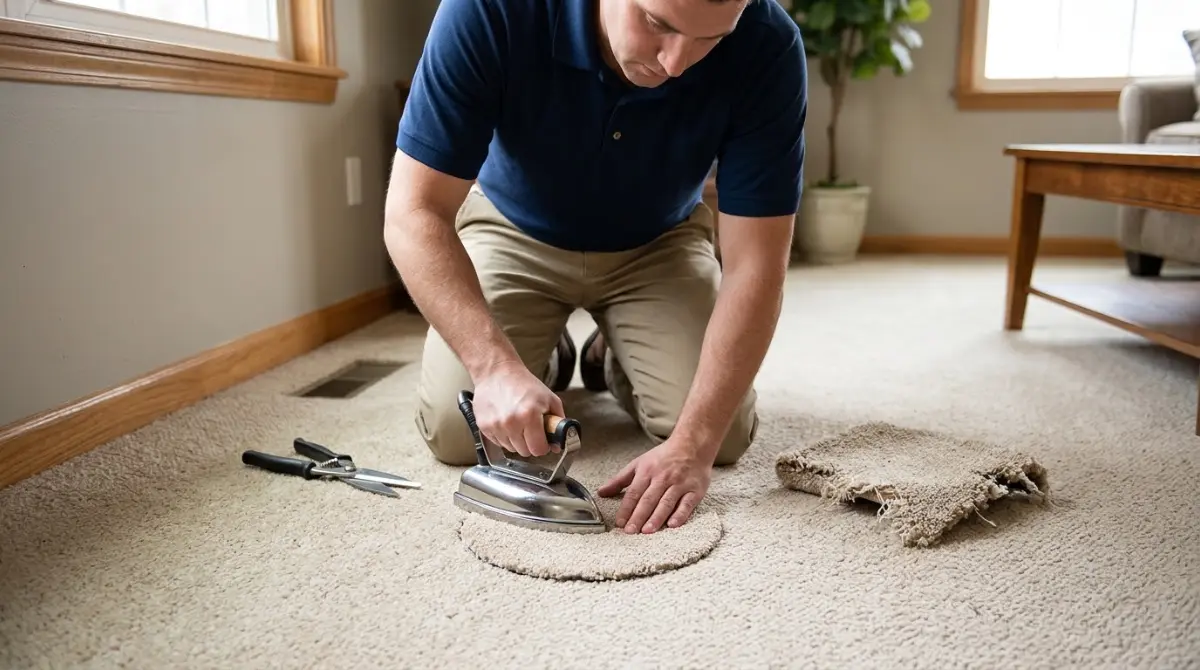
Puppy, bored, closed bedroom door. You can probably picture the rest. The carpet right at the threshold, chewed down to the backing in a ragged half-moon, little tufts of beige fuzz everywhere, and a dog looking at you like nothing happened. That exact scene is behind a lot of the calls I get about how to patch carpet. The rest are candle burns, iron burns, bleach spots, and the occasional “my kid cut it with scissors, don’t ask.”
Good news first. Most of these can be fixed so you’d have to get down on your hands and knees to find the spot. Sometimes not even then.
You cut out the damaged piece. You cut a matching piece from somewhere else. You glue the new piece in, with the pile running the same way. That’s it, in theory. In practice the difference between a patch you can’t see and one that looks like a postage stamp is all in the details.
Proper carpet patching is called a bonded insert, if you want the fancy term. New piece goes down on seam tape, hot-melt glue on the tape. Edges get fused so they won’t fray on you. Then you brush the pile back and forth with your fingers till the seam just kind of… vanishes. On a good day.
Before anybody talks about how to patch carpet, you need the donor. This is where most DIY jobs fall apart.
Leftover scraps are gold. Check the garage rafters, behind the furnace, under the basement steps with the Christmas stuff. Previous owners left them more often than you’d think. Rolled up, dusty, perfect.
No scraps? Then we steal from inside a closet. Back corner, under where the shoes go, a spot nobody ever sees. We cut the donor, then fill the closet hole with a piece of something close in color or a remnant. Nobody’s checking the floor of your coat closet. Promise.
A word on color. Even carpet from the same roll fades differently once it’s been down a few years. The room by the sunny window will be lighter than the closet. So the patch might look a hair different at first. Usually a good cleaning of the whole area helps it blend, and after a few months of normal wear it catches up.
This part makes people nervous, and fair enough, you’re cutting a hole in carpet on purpose.
We use a cookie-cutter style tool or a sharp carpet knife with a straightedge. Cut from the back if possible, or part the pile and cut between rows of tufts from the top so you’re not slicing yarn in half. Square or rectangle shapes are easier than circles for most people, but honestly circles blend better on some patterns. Depends on the carpet.
Cut just past the damage. Not way past. Bigger isn’t better here. Smaller patch, less edge to hide.
Then use the old piece as a template for the donor. Same size, same direction. I draw a little Sharpie arrow on the back of both pieces, pointing which way the pile leans. Skip the arrow and that patch reads darker from the doorway and lighter from the couch (light bouncing off the yarn tips, basically), and you’ll stare at it every night forever. That’s the number one tell on a bad patch.
Hot-melt seam tape goes under the hole, centered, sticky side up. Heat it with a seaming iron (or the household iron on low with a towel, if you’re DIY and brave). Press the patch in. Weight it down. Let it cool. Then brush the pile together with your fingers or a stiff brush till you can’t see the line.
Some people use carpet glue or double-sided tape. Works for a little while. Then the edges curl up and the vacuum catches them and you’re back to square one.
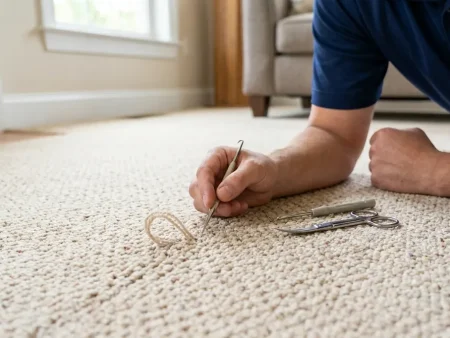
Strange but true. Little candle burn on cut pile? Half the time I don’t even get the knife out. Only the tips melted, so I grab a tiny pair of cuticle scissors and snip the crispy brown ends off, a few yarns at a time. Gone.
Deeper burns that melted down to the backing need a proper insert. Also, if you’ve got a candle habit, the folks at the CPSC have plenty to say about candle and home fire safety. A melted spot in the carpet is the lucky version of that story.
We see a lot of fireplace and wood stove burns in older stone and farmhouse places. Little ember pops out, lands on the rug, nobody notices till the smell. Folks out near Jarrettsville Pike book carpet repair Hydes MD for exactly that, every winter, like clockwork. Same deal for horse-country houses further north that need carpet repair Monkton once the fireplace season gets going.
Sorry. Had to.
Chewing and digging usually happens at doorways, because that’s where the dog wants to get through. The trouble is doorways are also where carpet meets a tack strip or a transition, so a patch there sometimes means re-securing the edge too. And if the dog dug long enough, the carpet’s probably pulled loose and wrinkled across the room. Then you’re looking at a power stretch along with the patch.
Cats are different. They pull. Loop pile (berber) is the worst for this, because one snagged loop turns into a run. Small runs can be glued back down without a full patch. Long ones need a strip insert. Honestly if you have cats and you’re shopping, cut pile beats loop every time.
If there’s also urine damage, fix the odor first. No sense putting a beautiful patch over a smelly pad.
Look, I’m not going to pretend nobody can do this at home. A handy person with patience, a sharp knife, and a donor piece can absolutely learn how to patch carpet well enough for a spot under the bed or in a closet. Cheap kits at the hardware store come with a round cutter and some tape.
Where I’d call someone:
That last one is the big one. Botch the cut and your one perfect scrap is gone. Then every option gets worse.
People live with damage for years. I get it, it’s one spot, there’s a chair over it, life’s busy. But a small hole in carpet doesn’t stay small. The backing frays a little more every time the vacuum goes over it. Edges unravel. Tufts get pulled out by the beater bar, one at a time, and the dog keeps working on that same corner because it’s already loose and fun.
What starts as a quarter-sized spot is a fist-sized spot by next spring. A bigger cut means a bigger donor, and you may not have a big enough scrap anymore.
So in the meantime? Turn off the beater bar when you vacuum over it, or just skip that spot. Throw a bath mat over it so Grandma doesn’t catch a toe. Duct tape? No. That gunk gets into the yarn and I spend twenty minutes picking it out before I can start. A loose strand poking up gets snipped flush with scissors, never yanked. Pulling a tuft on loop carpet can unzip a whole row.
Sometimes the carpet’s just tired. Matted, worn through in the traffic lanes, stained in six other places. Patching one hole in that floor is putting a nice new tire on a car with no engine. I wrote about repair or replace carpet decisions if you’re stuck on that.
And if the whole room’s got ripples and bubbles along with the damage, that’s a stretch problem, not just a patch problem. There’s more on why carpet ripples in another post.
If you do end up replacing, we handle new carpet sales and carpet installation in Glen Arm and all around the area, and every installation gets a lifetime warranty. Right now, though, most Glen Arm folks calling about carpet repair Glen Arm MD just need one bad spot fixed, not a whole new floor.
Dining rooms get the combo platter. A wine bottle tips into a lit candle and you’ve got wax, wine and a burn in one spot. Takes a patch, but if there’s a big closet to steal from, it disappears.
Stairs in rowhomes are another regular, usually a dog working on the nosing of a few steps. Stairs are fussy. You’ve got a fold over the edge, and the patch has to wrap it without a visible line. Takes a while. Worth it.
And plenty of plain old iron burns. Somebody irons a shirt on the floor because the board’s buried in the closet, gets distracted, there’s a perfect triangle burned into the carpet. Very fixable. Kind of funny, after.
We’re based in Cockeysville, so carpet repair Cockeysville MD calls are basically down the street from us. We go out east toward Harford Road for carpet repair Carney jobs, way up north for carpet repair Hereford MD, and west past the Beltway for carpet repair Owings Mills customers. Lots of ground. We don’t mind the drive.
Extreme Carpet Cleaning LLC is family-owned since 1998, started by Shawn Mullikin. IICRC certified technicians. And there’s a 150% money-back guarantee on our cleaning and repair work, so if the patch isn’t right, we fix it.
So that’s how to patch carpet, more or less. Find a donor, cut clean, match the pile direction, hot-melt it in, brush it out. Easy to say. Takes practice to make invisible. Good carpet patching honestly comes down to patience, and the guy with the knife caring about it.
Got a hole in carpet you’re staring at right now? Grab a quick phone pic of it, then call (410) 666-6600 or request a free quote online, whichever’s easier. And maybe close the bedroom door with the puppy on the other side. Just a thought.


Tell us a little about your project. We’ll come out, take a look, and send you a written quote within one business day.